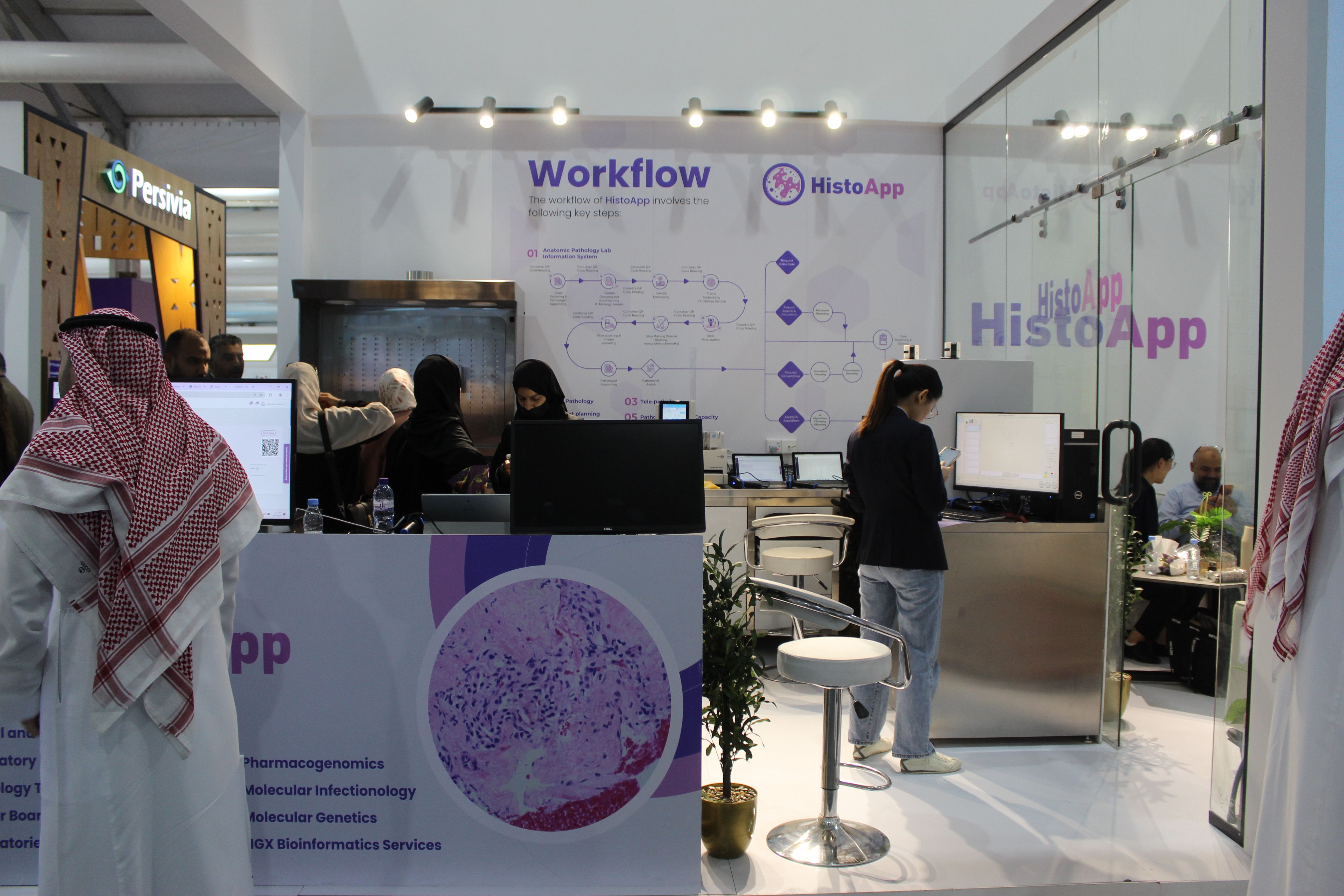
A Saudi Healthtech Success Story: HistoApp’s Mission to Digitize Pathology
We’re proud to present a new interview as part of our Saudi Startup Success Stories series, created in partnership with StartupBlink and the National Technology Development Program (NTDP). This series highlights visionary founders building globally competitive companies while advancing Saudi Arabia’s rapidly evolving health-tech and deep-tech innovation landscape.
This conversation features Ahmed Al-Mahlki, Founder and CEO of HistoApp, a Saudi digital health company transforming how pathology diagnostics, collaboration, and clinical decision-making are performed through digital and AI-enabled workflows. With more than 25 years of experience in software development, technology strategy, and government-led technology initiatives, Ahmed’s journey into healthcare innovation began not in medicine, but through a deeply personal experience that exposed critical gaps in diagnostic accessibility and second-opinion pathways.
HistoApp was born from this intersection of personal insight and technological expertise, aiming to eliminate delays caused by manual pathology workflows and geographic limitations in accessing specialist expertise. By digitizing pathology slides and enabling secure remote collaboration supported by AI-assisted analysis, the company is helping modernize one of healthcare’s most essential, yet historically under-digitized, medical disciplines.
Saudi Arabia’s rapidly advancing innovation ecosystem has played a defining role in HistoApp’s growth. National initiatives such as NTDP have provided not only funding support, but also regulatory guidance, institutional connections, and validation within a highly regulated healthcare environment. Today, HistoApp contributes to the Kingdom’s vision of building secure, locally developed, and globally scalable medical technologies, positioning Saudi Arabia at the forefront of precision diagnostics and AI-driven healthcare transformation.
How did the idea for HistoApp first come to life, and what problem in pathology or diagnostic workflows were you most driven to solve?
The idea behind HistoApp emerged from a deeply personal experience that ultimately revealed a systemic gap in global healthcare. When a close family member experienced kidney failure, we discovered that the initial diagnosis was incorrect, but correcting it required physically transporting pathology slides abroad for a second opinion. During this process, we faced unexpected logistical barriers, including restrictions on carrying medical specimens during international travel and delays caused by manual slide transfer.
By the time the correct diagnosis was confirmed, treatment options had narrowed significantly. That moment exposed a critical reality: access to expert pathology opinions should never depend on geography, logistics, or patient awareness.
Professionally, I come from a technology and strategy background rather than medicine. I graduated in Computer Science and bring more than 25 years of experience across software development, digital strategy, and government technology initiatives. Earlier in my career, I founded a software development company before transitioning toward building scalable product-based platforms instead of project-based solutions.
This combination of personal experience and technical expertise led me to ask a simple question: Why can’t patients and clinicians access multiple expert pathology opinions digitally and instantly?
From there, HistoApp was born.
Starting in late 2022, we established an international medical advisory board chaired by leading Saudi pathologists and global experts. Together, we analyzed real clinical pain points, from slide handling and collaboration barriers to diagnostic delays, and designed a three-year strategy to digitally transform pathology workflows.
Today, HistoApp digitizes pathology end-to-end: enabling remote consultations, AI-assisted analysis, tumor board collaboration, and faster clinical decision-making, ensuring that diagnostic accuracy is no longer limited by physical infrastructure.

What makes Saudi Arabia an attractive environment today for building digital health and AI-driven HealthTech startups like HistoApp?
Saudi Arabia offers one of the most structured and supportive environments globally for HealthTech innovation. Vision 2030 has created a healthcare system that is fundamentally digital-by-design, supported by strong institutional collaboration and long-term national investment.
Equally important is the ecosystem mindset. Government entities, regulators, hospitals, investors, and innovation programs operate in coordination rather than isolation. For founders, this significantly accelerates validation and deployment.
Programs such as the Ministry of Health Sandbox allow startups to test solutions safely within regulated clinical environments, ensuring innovation progresses alongside patient safety and data governance.
This balance between innovation and trust makes Saudi Arabia uniquely positioned to lead AI-driven healthcare transformation.
How important have government-led initiatives and national innovation programs been in supporting your journey as a founder?
Government-led initiatives have been instrumental to HistoApp’s development.
Participation in the Ministry of Health Sandbox enabled us to clinically validate our telepathology workflows before large-scale deployment. This ensured our platform met national standards for data security, interoperability, and diagnostic reliability.
Support from the National Technology Development Program (NTDP) has been particularly impactful, not only through funding but through ecosystem access. NTDP connected us with hospitals, cybersecurity validators, infrastructure providers, regulatory bodies, and clinical stakeholders.
These connections accelerated both product development and market readiness. For example, NTDP facilitated collaboration opportunities, regulatory navigation, and even international exposure initiatives such as this interview.
For deep-tech healthcare startups, this type of structured ecosystem support bridges the critical gap between innovation and commercialization.
Are there any R&D initiatives or upcoming innovations, particularly around AI-powered pathology, that you’re especially excited about?
Our focus is advancing pathology AI beyond image recognition toward clinical decision support.
HistoApp’s architecture is intentionally technology-agnostic. We do not lock users into specific scanners or proprietary AI engines. Instead, our platform integrates with multiple imaging systems and allows disease-specific AI tools to be added seamlessly.
Currently, our R&D efforts focus on combining pathology morphology, genomic data (NGS), and clinical history into unified AI models capable of supporting treatment planning, particularly for oncology cases.
Importantly, our philosophy is augmented AI. The goal is not to replace pathologists but to enhance diagnostic confidence through prioritization, pattern detection, and workflow automation.
Due to healthcare cybersecurity and patient privacy requirements, our AI infrastructure is developed and deployed locally, ensuring compliance with national data protection standards.
What milestones are you most proud of achieving so far with HistoApp?
Our proudest milestones center around trust and clinical adoption.
Since conceptualizing HistoApp in 2022, we have successfully:
- Established an international medical advisory board,
- Completed Proof of Concept deployments across Ministry of Health facilities,
- Implemented solutions in advanced healthcare environments including NEOM Hospital,
- Graduated from the MOH Sandbox,
- Secured NTDP deep-tech support,
- Built partnerships with global healthcare leaders such as Huawei, AstraZeneca, and Hologic.
Additionally, more than 100 pathologists worldwide now collaborate within our ecosystem, many contributing voluntarily to expand access to second opinions, particularly for underserved regions. We have even supported developing countries by deploying digital pathology scanners to enable remote diagnostics.
What are your key goals for HistoApp over the next five years?
Our primary objective is to establish HistoApp as Saudi Arabia’s national digital pathology backbone, fully integrated with NPHIES and national healthcare infrastructure.
Regionally, we aim to expand across GCC and MENA markets, where shortages of subspecialized pathologists remain a significant challenge.
Technologically, our long-term vision is predictive pathology, evolving from workflow digitization into a Clinical Decision Support System capable of helping clinicians predict treatment response and personalize therapies using large-scale clinical and imaging datasets.
What excites you most about the future of digital health and the broader tech ecosystem in Saudi Arabia?
What stands out in Saudi Arabia today is ecosystem maturity.
Startups benefit from coordinated collaboration between ministries, regulators, investors, and innovation programs. Access to infrastructure, APIs, funding channels, and institutional partnerships significantly lowers barriers to innovation.
The country is not merely adopting technology, it is actively enabling startups to build globally competitive solutions. This integrated ecosystem allows founders to focus on solving meaningful problems rather than navigating fragmentation.
What advice would you give entrepreneurs looking to build or expand startups in Saudi Arabia?
My advice is simple: engage deeply with the ecosystem.
Saudi Arabia actively supports startups willing to align with national priorities and deliver real impact. Regulatory challenges, integration requirements, and implementation barriers can be solved through collaboration with government programs and innovation platforms.
Healthcare innovation, and deep technology in general, moves at the speed of validation. Founders who respect this process, invest in R&D, and build trusted partnerships will find Saudi Arabia one of the most supportive environments for long-term growth.
Want to Get in Touch?
Have something to share or explore within the ecosystem? Let us know how we can help — from adding events and opportunities to discussing partnerships or ideas.
This portal and contact form are fully operated by StartupBlink, the global platform supporting ecosystem growth worldwide.